This infographic analyzes the consequences of USAID’s 2023–2024 restructuring, which led to the termination of 5,341 projects and the defunding of 2,353 implementing partners, many of whom lost 100% of their USAID support. Over 55% of recipient countries lost all funding. The analysis extends beyond the U.S. to consider concurrent budget contractions by other donor countries, indicating a systemic shift in how foreign aid is prioritized and delivered. The infographic visualizes these changes, offering insights into the scale, distribution, and potential implications of a more constrained and transactional development aid environment.
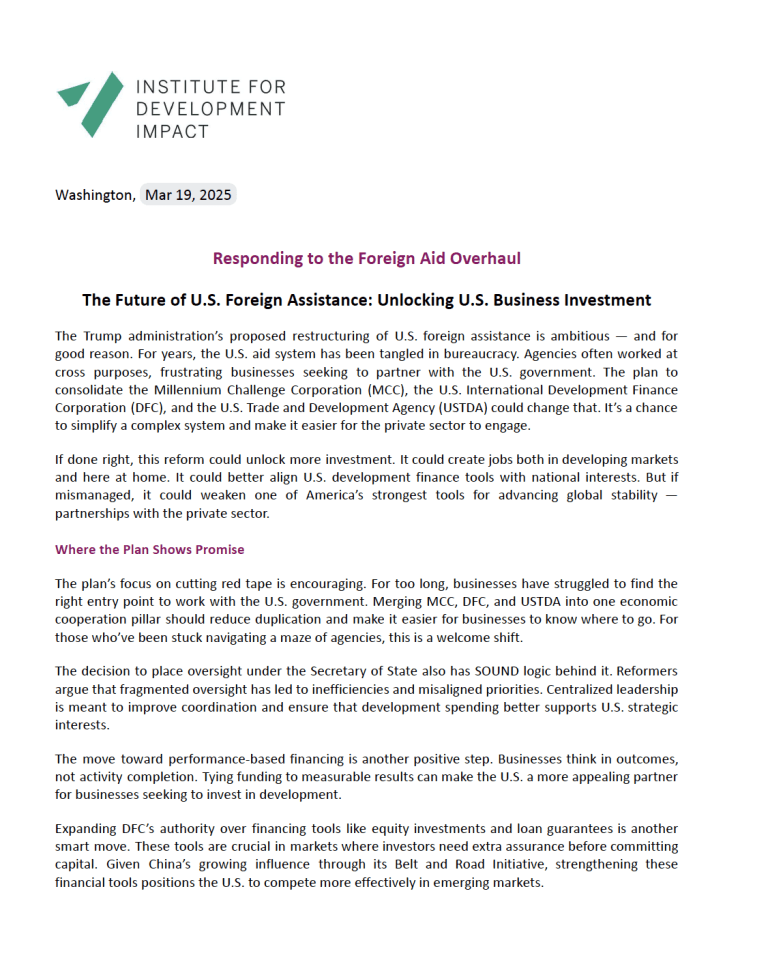
This article examines the Trump administration’s proposed restructuring of U.S. foreign assistance, which seeks to streamline agencies and align aid with investment-driven growth. The plan introduces promising steps to improve efficiency and expand opportunities for U.S. businesses abroad. However, the transition also brings important considerations, such as ensuring continued access to technical expertise, maintaining regional flexibility, and supporting financing tools that encourage investment in higher-risk markets. The piece outlines ways to maximize the benefits of these reforms while addressing potential challenges to ensure the new structure drives sustainable growth and impact.
The infographic, The Value of U.S. Global Health Investments, highlights the critical impact of U.S. foreign assistance in combating infectious diseases, strengthening health systems, and improving health security worldwide. It presents key achievements in reducing mortality and disease incidence, improving case detection, and expanding treatment and surveillance capacity. The data emphasize the long-term benefits of global health programs, including lives saved, enhanced laboratory and diagnostic capabilities, and effective outbreak prevention. The infographic also warns of the risks posed by funding cuts, showing how reducing support for global health initiatives could lead to increased vulnerabilities and higher costs in future crises.
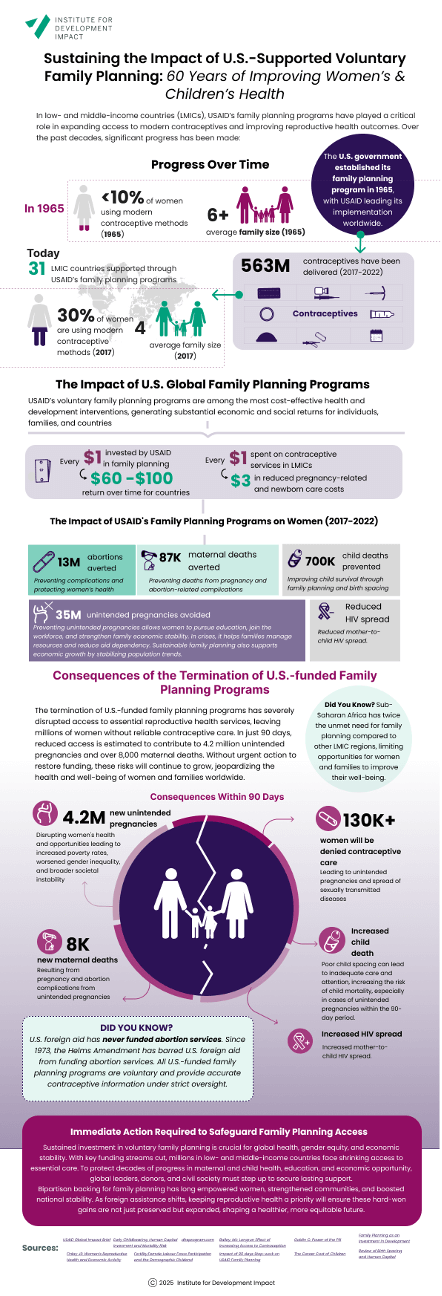
For six decades, U.S.-supported voluntary family planning programs have expanded access to contraception, improving maternal and child health, advancing gender equity, and strengthening economic resilience in low- and middle-income countries (LMICs). However, recent funding terminations threaten to reverse these gains, leaving millions without essential reproductive health services. This infographic highlights the impact of family planning investments, the consequences of funding disruptions, and the urgent need for sustained global support. As foreign assistance policies shift, ensuring continued investment in reproductive health is critical to safeguarding progress and fostering a healthier, more equitable future.
U.S. foreign assistance agencies have the potential to transform how they engage with the private sector, fostering partnerships that drive sustainable development. This white paper explores the structural barriers that have hindered effective collaboration and presents a bold rethinking of private sector engagement in U.S. foreign aid. Drawing on I4DI’s extensive experience in evaluating and facilitating public-private partnerships, the paper advocates for a shift from rigid, bureaucratic processes to an investment-driven approach that aligns with private sector needs. Key recommendations include modernizing financial instruments, decentralizing decision-making, and introducing measurable success metrics to unlock greater private sector participation. By embedding businesses as core partners rather than peripheral contributors, U.S. foreign assistance can become more agile, impactful, and investment-oriented.
USAID isn’t just about foreign aid—it’s an investment that pays off for the U.S. in big ways. For every $1 put into agricultural research, the return is $8.52, fueling jobs, exports, and economic growth. Slashing USAID’s budget doesn’t just hurt development programs abroad; it hits home—putting over 200,000 American jobs at risk and cutting $23 billion from U.S. exports. The impact goes beyond economics. Without USAID, millions lose access to food, healthcare, and education, fueling instability that threatens U.S. security and trade. And yet, USAID’s budget is a fraction of what the U.S. spends on defense. In a time of global uncertainty, weakening one of the most effective tools for economic growth and stability is a risk the U.S. can’t afford.
This visualization examines the multifaceted impact of food wastage through two key lenses: supply chain losses and their corresponding environmental and economic consequences. The analysis reveals that 37% of losses occur during consumption, with over 60% at the household level. Environmental impacts include significant greenhouse gas emissions (8-10% of global emissions), water waste (1/4 of global freshwater use), and land degradation (28% of agricultural land). Economic damages total $394B annually, with additional health-related costs of $150B. The infographic concludes by presenting practical mitigation strategies across the supply chain, emphasizing the need for integrated solutions from production to consumption.
This document outlines the Pathways to Living Income farmer segmentation model, which categorizes farmers along the dimensions of resources, productivity, and empowerment. The segmentation aims to provide a targeted approach for supporting diverse farmer groups in achieving sustainable livelihoods. By offering detailed insights into the specific challenges and opportunities of each segment, the model guides stakeholders in designing tailored interventions that enhance productivity, resource access, and decision-making power. Ultimately, the model supports efforts to move farmers toward achieving a living income, ensuring resilience and long-term economic stability in smallholder agricultural systems.
The textile industry’s immense global impact spans environmental and social dimensions, with annual consumption of 93 billion cubic meters of water and generation of US $1.3 trillion in revenue. This infographic by the Institute for Development Impact (I4DI) illustrates the industry’s scale while highlighting critical sustainability challenges and proposed solutions through I4DI’s three-pronged approach focusing on livelihood support, environmental footprint reduction, and impact measurement.
Indonesia is one of the world’s leading cocoa producers, yet the sector faces significant challenges due to climate change, including altered precipitation patterns, rising temperatures, and extreme weather events. This infographic delves into how agroforestry, a creative agricultural approach that integrates trees into cocoa farming landscapes, offers a sustainable solution to these challenges. Climate-smart Diversified Cocoa Agroforestry (DCA) practices not only enhance soil health and reduce erosion but also boost crop productivity by creating a more biodiverse and resilient ecosystem. The infographic highlights the specific effects of climate events on cocoa production, such as increased fungal attacks and prolonged droughts, and showcases how agroforestry can mitigate these impacts.
There is a lack of rigorous research on child labor, forced labor, and human trafficking that, along with fragmentation in research efforts, suggests a need to bring researchers and policy actors together around a common research agenda that creates interdisciplinary consensus building. To be sustainable, this process needs to work across disciplinary, country, and generational gaps to generate research-to-practice products that are based on high-quality, context-specific research. To address the need to produce high-quality data that can be used by researchers, policy actors, and decision-makers, the United States Department of Labor (USDOL) provided grant funding to the International Labour Organization (ILO) to implement two projects. On August 3, 2018, USDOL awarded a cooperative agreement grant to the ILO to implement the Research to Action (R2A) project at the global level. On December 12, 2019, USDOL awarded another grant to the ILO to implement the Evidence to Action (E2A) project, which operated in Argentina and Madagascar.